
AIMuseVideo
Native audio · High-fidelity video generation

AI Muse Video brings prompts to life with picture and sound.

Generate coherent video with native audio, precise prompt adherence, strong visual fidelity, and consistent motion from frame to frame.

AI Video

Core model capabilities

Generate complete scenes with AI Muse Video.

Muse Video combines sound, visual detail, prompt control, and temporal coherence in one video generation model.

Generate native audio with the video

Sound and visuals are generated as one media experience, giving each scene ambience, effects, and acoustic direction from the initial prompt.

Current limitation: precise audio-video synchronization still needs improvement.
Exceptional visual fidelity

Preserve fine detail, lighting, texture, and scene composition across high-quality generated footage.

Temporal consistency across a moving scene

Keep subjects, composition, and scene structure coherent from frame to frame as the camera and objects move.

Direct the scene with precise prompts

Control the subject, setting, action, camera movement, atmosphere, and sound direction through natural-language prompts.

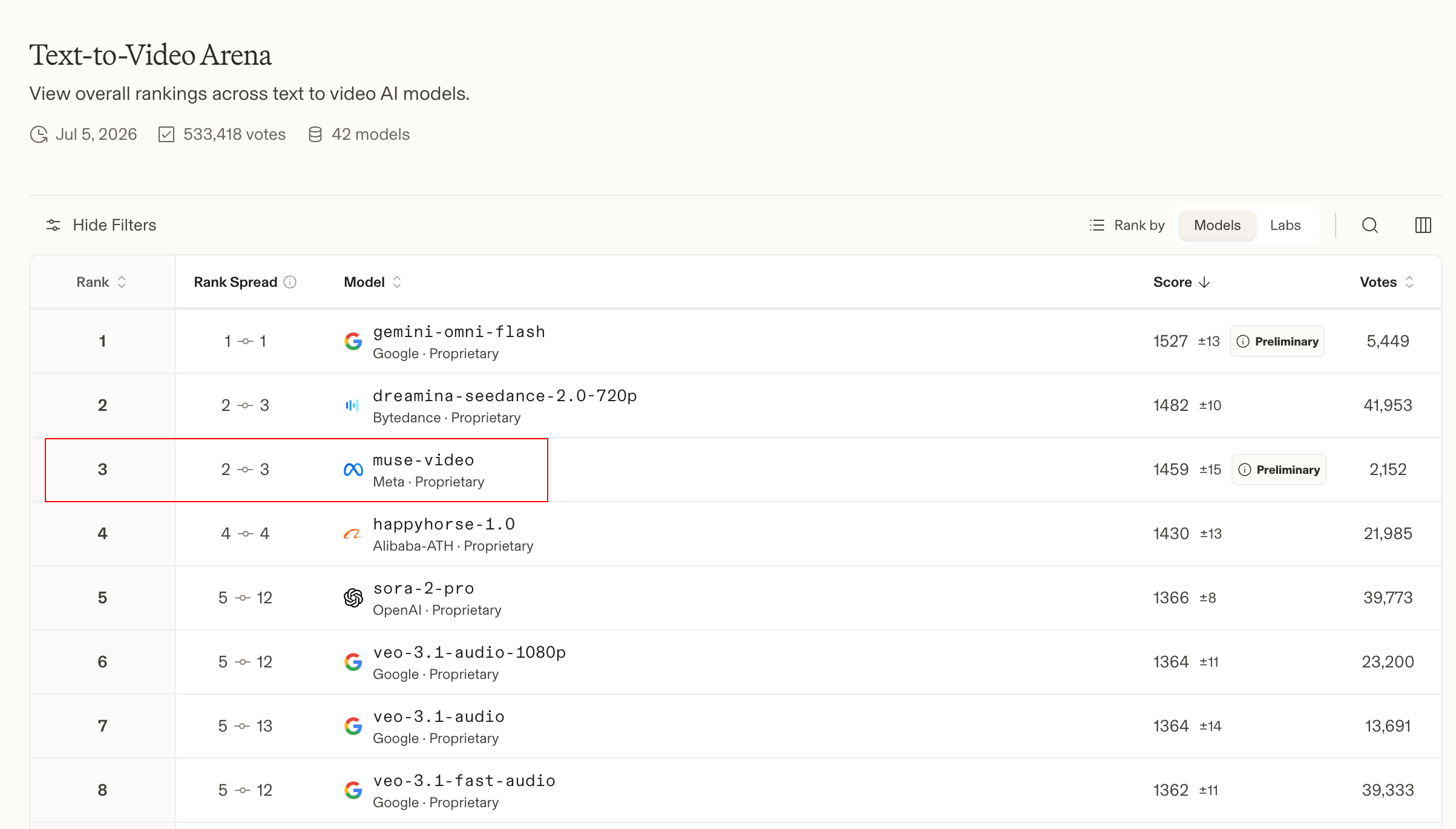
Top-three text-to-video preference ranking

Muse Video reached No. 3 in the text-to-video human-preference Arena ranking reported on July 5, 2026.

Text-to-Video Arena ranking showing Muse Video in third place

What makes AI Muse Video stand out

The model is built around six practical strengths for creating coherent, directed video.

Native audio support

Generate picture and sound together instead of exporting a silent visual clip.

Exceptional visual fidelity

Retain visual detail, materials, lighting, and composition throughout the scene.

Competitive prompt adherence

Keep generated scenes aligned with written subjects, actions, settings, and camera direction.

Strong temporal consistency

Subjects, composition, and motion are designed to remain coherent over time.

Unified media generation

Build motion, scene detail, and audio as parts of one coordinated generation process.

Top-three preference result

Ranked No. 3 for text-to-video human preference as of July 5, 2026.

Meta Muse Video and the evolution of Meta video generation

Muse Video follows several generations of Meta research, moving from short text-conditioned clips toward higher-fidelity video with integrated sound.

2022

Make-A-Video

Meta’s early text-to-video research combined text-image knowledge with unlabeled video motion, and could also animate images.

2023

Emu Video

A factorized generation method first created an image from text and then generated video conditioned on both text and image.

2024

Movie Gen

Meta introduced high-quality 1080p video generation with corresponding audio tracks and creator-focused experimentation.

2026

Muse Video

The first video model preview from Meta Superintelligence Labs combines the Muse pretraining foundation with native audio support and competitive fidelity, prompt adherence, and temporal consistency.

Creative workflows

Use AI Muse Video across the production process.

Social media marketers

Prototype product reveals, campaign scenes, and branded short-form concepts with visual and audio direction in one prompt.

Filmmakers and pre-production teams

Explore establishing shots, camera motion, scene rhythm, and sound ideas before a full production begins.

Short-form content creators

Develop concepts for Reels, Shorts, and vertical stories where picture and sound need to work together.

E-commerce and product teams

Visualize product demonstrations, lifestyle contexts, packaging reveals, and motion-led launch ideas.

Game and concept designers

Previsualize environments, cinematic beats, character moments, and narrative sequences.

Enterprise communications

Prototype training scenes, internal announcements, presentation visuals, and campaign storyboards.

Meta Muse Video vs Veo 3 vs Sora 2

A source-based comparison of published positioning and availability — not a fabricated quality score.

DimensionMeta Muse VideoVeo 3Sora 2
Published statusEarly preview announced July 2026.Released in Google’s creative products.Video-and-audio model; API documentation currently labels it legacy.
AudioNative audio support announced.Native audio, including ambience, effects, and dialogue.Synchronized dialogue, sound effects, and soundscapes.
Published strengthsPrompt adherence, visual fidelity, and temporal consistency.Cinematic generation and filmmaking workflows in Flow.Control, realism, multi-shot direction, and physical behavior.
Published caveatMeta is improving audio-video sync and physically accurate fast motion.Availability varies by Google product, plan, and region.OpenAI says the model remains imperfect; the standalone product is no longer available.
AccessComing soon to creators and Meta AI.Gemini and Flow through eligible Google AI plans.Legacy API model availability, subject to OpenAI documentation.

Sources: official announcements from Meta, Google, and OpenAI. Availability can change after publication.

What makes it unique

What sets AI Muse Video apart

Muse Video treats visuals, motion, prompt intent, and sound as one coordinated generation problem.

Built specifically for video

Muse Video combines scene generation, motion coherence, prompt adherence, and sound within one video-focused preview.

Video and audio developed together

Generate visuals and native audio together, while accounting for the current synchronization limitation.

Known limits, clear next steps

Audio-video synchronization and physically accurate fast motion remain the main areas for improvement.

FAQ

AI Muse Video — frequently asked questions

Capabilities, availability, ranking, and current limitations in one place.

Create your next scene with AI Muse Video.

Write the scene, set the frame, and generate a coherent clip with visual and audio direction in one workflow.

Try AI Muse Video